Categories
Real EstatePublished April 23, 2026
Renting vs. Buying on the Eastside: An Honest 2026 Analysis

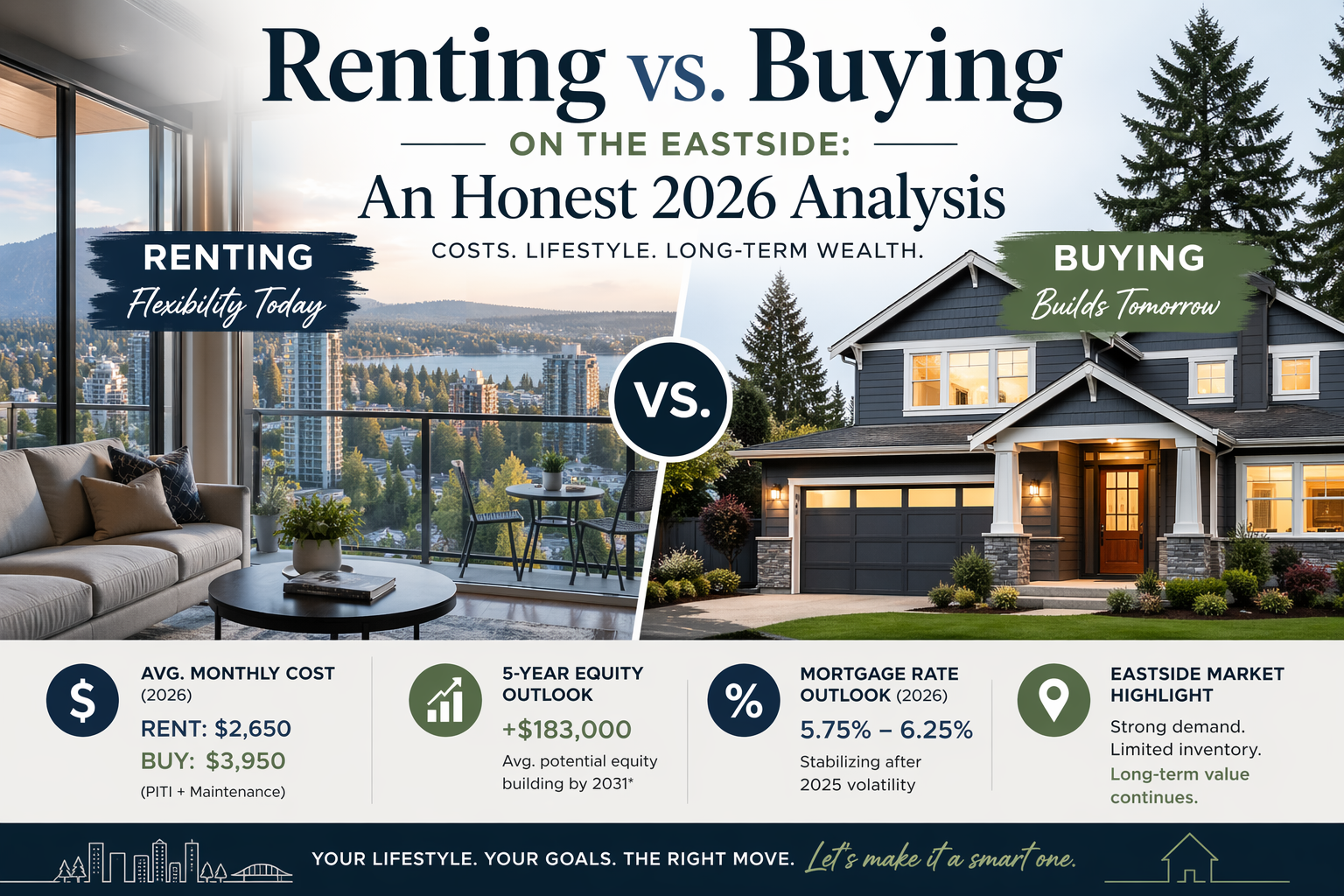
Renting vs. Buying on the Eastside: An Honest 2026 Analysis
This is one of the most common conversations I have, and I want to be upfront about something: as a real estate agent, I have an obvious interest in you buying a home. So take what follows as honestly as I can make it — because my goal is to give you the analysis that is actually right for your situation, not just the one that leads to a transaction.
The rent-versus-buy question on the Eastside in 2026 is genuinely complicated. Here is how to think through it.
The Cost of Renting on the Eastside
A three-bedroom rental in Sammamish or Kirkland currently runs $3,200 to $4,200 per month for a decent home. A four-bedroom in a good school district can easily exceed $4,500. These are not hypothetical numbers — they reflect what my clients and friends are paying right now.
Renting is not cheap on the Eastside. And unlike a mortgage payment, rent money builds zero equity. You are essentially paying for the right to live somewhere, and at the end of every month, your net worth is unchanged.
The True Cost of Buying
Buying a median Sammamish home at $1.6 million with 20 percent down means a loan of $1.28 million. At 6.5 percent, that is a monthly principal and interest payment of roughly $8,100. Add property taxes, homeowner's insurance, and possible HOA dues, and your total monthly housing cost approaches $9,500 to $10,500.
That is significantly more than renting. And that gap is real. Anyone who tells you buying always makes mathematical sense in the short term is not being honest with you.
Where Buying Wins: Equity, Appreciation, and Tax Benefits
The case for buying is built on three legs. The first is equity accumulation. Even in the early years of a mortgage — when most of your payment goes toward interest — you are making progress on principal and benefiting from whatever appreciation occurs.
The second leg is appreciation. Sammamish has appreciated at an average of 6 to 8 percent annually over the past decade, with significant variability year to year. On a $1.6 million home, even a 5 percent appreciation year adds $80,000 to your net worth. That is not guaranteed — markets can and do correct — but the long-term trend in Sammamish has been consistently upward.
The third leg is tax benefits. Mortgage interest and property taxes are deductible in many circumstances. Consult a CPA for your specific situation, but for high-income Eastside buyers, these deductions can meaningfully reduce the effective cost of ownership.
Where Renting Wins: Flexibility and Opportunity Cost
Renting wins when your time horizon is short. If there is any meaningful chance you will leave the Eastside in the next three to five years, buying is risky. Transaction costs — agent commissions, closing costs, moving expenses — typically consume 8 to 10 percent of the home's value. You need appreciation to overcome that before you break even.
Renting also wins when the alternative is depleting your emergency reserves to make a down payment. Buying a home with no financial cushion is not a wealth-building move — it is a financial risk.
The Honest Answer
If you plan to stay on the Eastside for five or more years, have a stable income, and can afford the down payment without draining your reserves, buying in Sammamish has historically been one of the best financial decisions people make. The combination of school quality, community strength, and long-term demand creates a market that rewards patient homeowners.
If your situation is uncertain — job changes possible, family plans in flux, timeline unclear — renting is not a failure. It is the right call. The worst real estate decision is buying a home you will need to sell in two years in a flat or declining market.
Not sure which side of this decision you are on? Let us look at the real numbers for your specific situation together.
simmi@simmirealestate.com | 425-324-6466
Our Other Blogs:
What Buyers and Sellers Need to Know in 2026- Read More
10 Questions Every Sammamish Buyer Should Ask Before Making an Offer- Read More
How to Read a Home Inspection Report- Read More

Simmi Kher
| Simmi Real Estate
or another way